What is an AI Agent? A Crash Course for Business Owners
Learn what AI agents are, how they differ from generative AI, and how they can automate multi-step business workflows with minimal supervision.
By 5050AI ·
Key takeaways
- AI agents act autonomously to achieve specific goals with minimal human intervention.
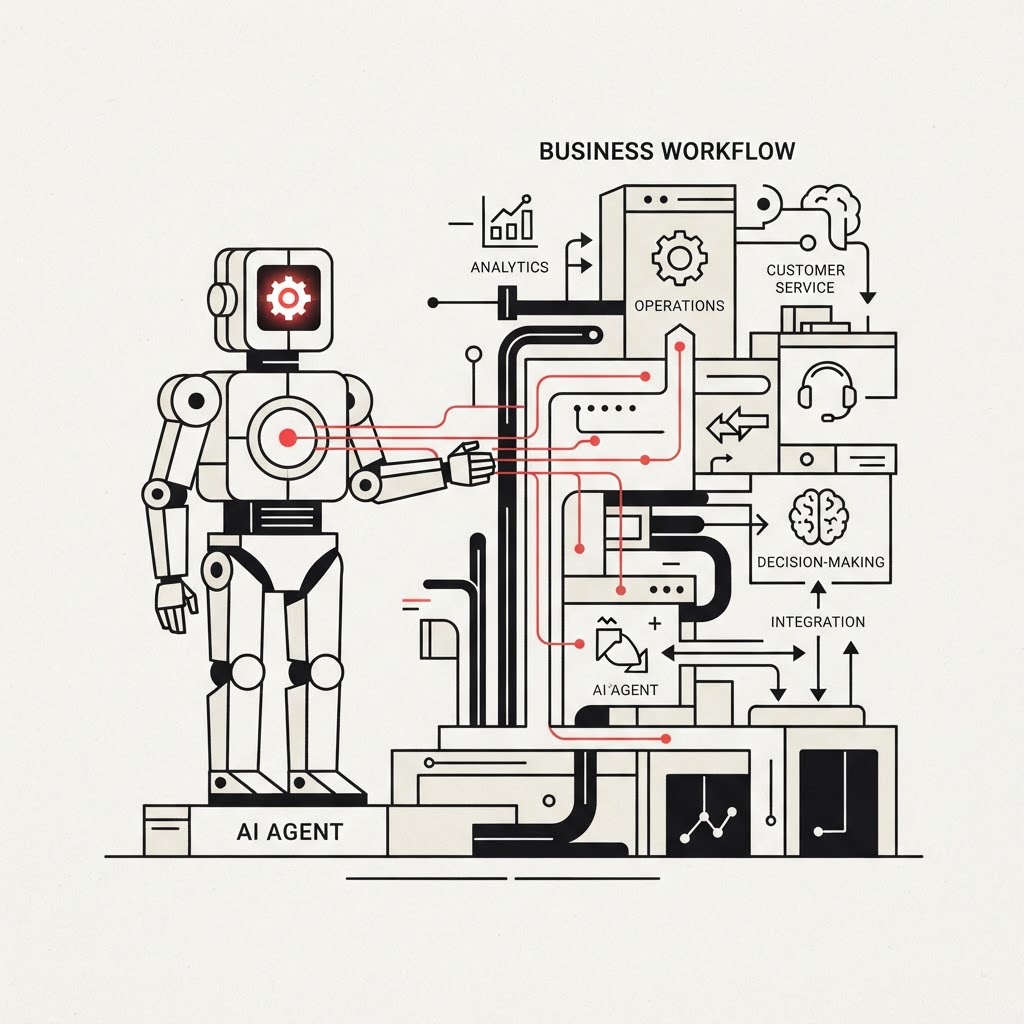
- Unlike standard generative AI, agents can execute multi-step workflows across business systems.
- They leverage LLMs and external integrations to perform tasks like fraud detection and process automation.
- Business leaders must weigh the operational benefits against risks regarding reliability and explainability.
An AI agent is an intelligent system designed to act autonomously to achieve specific goals with minimal human supervision (MIT Sloan, IBM). While many business leaders are familiar with generative AI, it is important to distinguish between content creation and true agency. Unlike generative AI, which focuses on producing text or images, AI agents make decisions and act to complete multi-step workflows (MIT Sloan, IBM). If you are looking to understand how these technologies differ, our Core Concepts of AI Generation & Agents guide provides a deeper look into the distinction.
How AI Agents Function
AI agents function by combining several sophisticated layers of technology. At their foundation, they utilize Large Language Models (LLMs) and machine learning to interpret instructions and reason through problems (MIT Sloan, IBM). However, the defining characteristic of an agent is its ability to interface with external tools and APIs (MIT Sloan, IBM). By connecting to your existing software stack, these systems can perform tasks across different platforms without constant human oversight. For those considering which operational tasks are ready for this technology, read our guide on what to automate first with AI agents in a service business.
Practical Business Applications
Because agents can navigate complex systems, they have broad applications for efficiency. Common deployments include:
- Financial Services: Automating loan approvals and implementing real-time fraud detection (MIT Sloan).
- Customer Experience: Providing full-cycle customer service automation that goes beyond simple FAQ chatbots (MIT Sloan).
- Operations: Streamlining business process optimization by handling routine, multi-step administrative burdens (MIT Sloan).
If you are ready to begin, how small businesses can pick their first AI agent serves as a starting point for vetting your initial use case.
Risks and Considerations for Business Owners
Implementing agentic AI is not without technical and ethical challenges. Businesses must prepare for irregular reliability, as autonomous systems may not always perform with the consistency of traditional software (MIT Sloan). Furthermore, there is a critical need for explainable decision-making so that managers can audit why an agent took a specific action (MIT Sloan). Ethical concerns also remain a priority, as businesses must ensure that their autonomous systems operate within safety and compliance boundaries (MIT Sloan). By prioritizing transparency and monitoring, you can mitigate these risks while exploring the potential of agent-driven workflows.
Frequently asked questions
Can an AI agent replace all human decision-making?
No. Due to risks regarding reliability and the need for explainable decision-making, human supervision remains necessary to ensure ethical and accurate outcomes.
How do agents differ from standard automation tools?
Standard automation typically follows rigid, pre-programmed rules. AI agents use LLMs and machine learning to reason through tasks, allowing them to adapt to new information and execute multi-step workflows autonomously.
Sources
- Agentic AI, explained, MIT Sloan
- Enterprise AI Agents: Beyond Productivity, IBM