Core Concepts of AI Generation & Agents
Explore the foundational shift from passive generative models to autonomous AI agents, including the roles of flow engineering, reasoning patterns, and security.
By 5050AI ·
Key takeaways
- AI agents leverage large language models as a central engine to autonomously perform multi-step tasks with minimal human intervention.
- Development is shifting from simple prompt engineering toward flow engineering to orchestrate complex, multi-step workflows.
- Core agentic systems rely on an iterative loop of perception, planning, action, and observation, often augmented by memory and reasoning patterns.
- Effective deployment requires addressing critical challenges like goal drift, infinite loops, and data security risks.
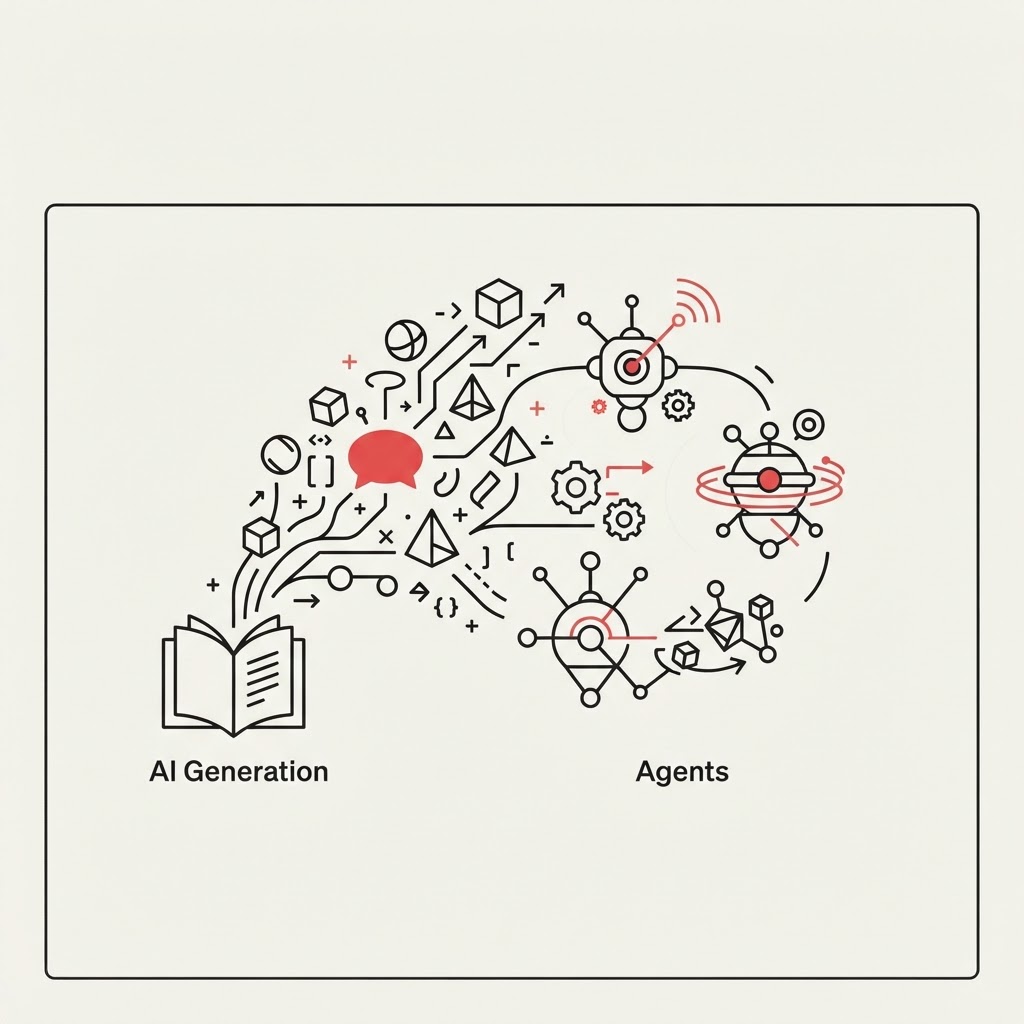
If you are moving beyond simple text generation, you are likely encountering the concept of the AI agent. At their most fundamental level, AI agents are systems that leverage models, tools, and data to autonomously perform multi-step tasks with minimal human intervention (IBM, NVIDIA). Unlike standard chatbots, which wait for a specific user prompt to trigger a static response, agents act as proactive performers that use large language models (LLMs) as a core engine or 'brain' to coordinate reasoning, planning, and decision-making (IBM, NVIDIA).
Understanding the Shift: From Models to Agents
The jump from a generative model to an agent is a shift in capability. While a model simply predicts the next token in a sequence, an agent operates within a functional architecture designed to achieve a specific outcome. As you evaluate what to automate first with AI agents in a service business, it is critical to recognize that agents are built to interact with the world, not just a prompt window.
The Anatomy of an AI Agent
Modern agentic behavior is powered by an agent loop, which consists of four primary phases: perception, planning, action, and observation (IJERT). This loop ensures that the system is constantly adjusting based on the results of its own output.
Reasoning Patterns
To handle complex logic, these systems use specific reasoning patterns, such as Chain-of-Thought or ReAct, to structure how the model approaches a task (IJERT). These methods allow the agent to break down a large objective into smaller, manageable logical steps. Furthermore, integrated memory systems allow the agent to retain context over time, which is essential for tasks requiring consistency.
Moving Beyond Prompting: The Role of Flow Engineering
AI development is rapidly moving away from simple prompt engineering toward flow engineering, which emphasizes the design and execution of multi-step workflows (IJERT). By combining LLMs with external tools—such as retrieval augmented generation (RAG) and specific APIs—agents gain the ability to retrieve current data and interact with external software environments (NVIDIA). If you are wondering how small businesses can pick their first AI agent, consider the specific tool integrations required to complete your most common manual processes.
Navigating Challenges in Deployment
Autonomous systems introduce new risks that traditional software does not face. The most prominent challenges include infinite loops, where a system becomes stuck in oscillation, and goal drift, where the agent loses sight of its original objective without a clear termination condition (IJERT). Additionally, security remains a primary concern; because agents are designed to interact with data and external tools, they introduce new attack vectors related to unauthorized data access and the misuse of integrated tools (NIST). Successful implementation requires robust oversight to ensure that the autonomy granted to the agent remains within defined operational bounds.
Frequently asked questions
What is the primary difference between a generative model and an AI agent?
A generative model is a tool for producing content based on input, whereas an AI agent is a system that uses a model as a brain to plan and execute multi-step tasks autonomously using tools and data.
What is flow engineering?
Flow engineering is a methodology in AI development that focuses on designing and orchestrating multi-step workflows rather than relying on a single, complex prompt to achieve a result.