
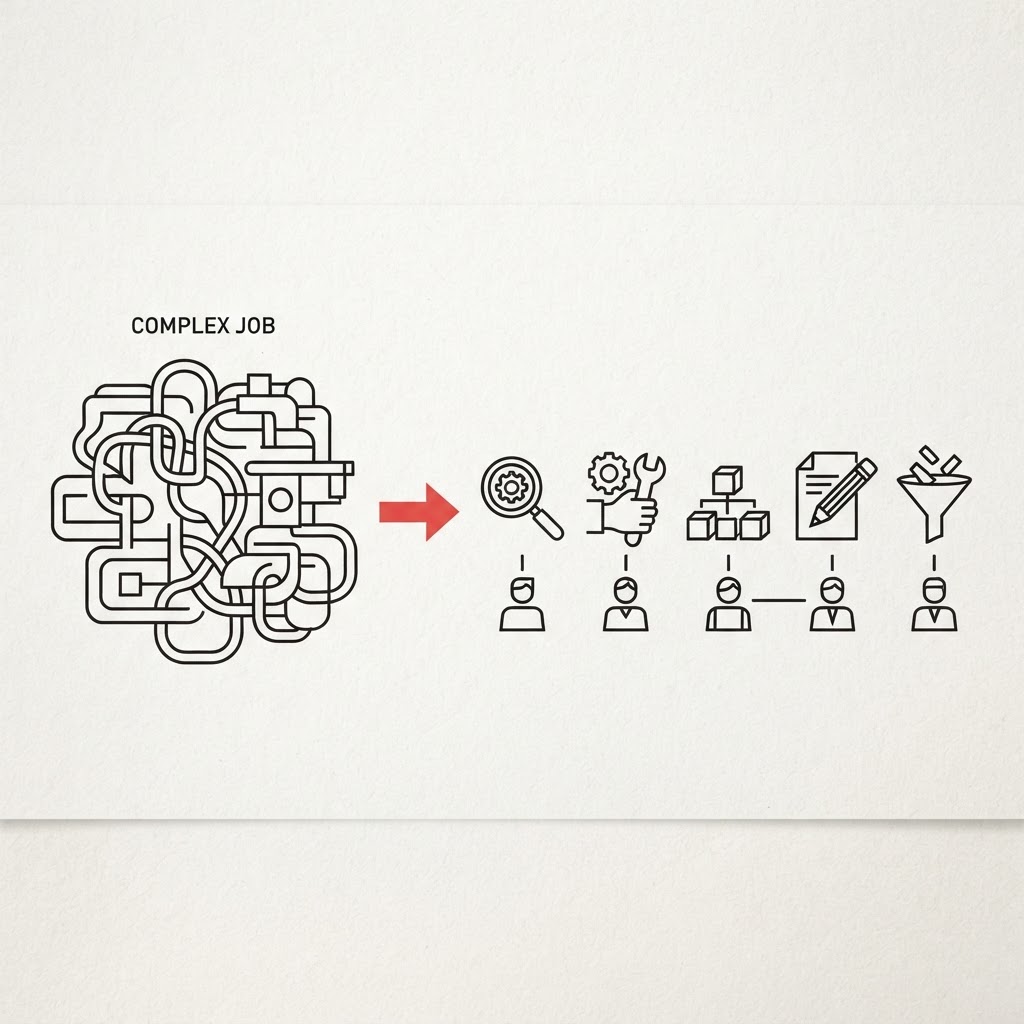
Break complex jobs down into narrow, specialized sub-agents!
Move beyond monolithic agents. Learn how to design modular, multi-agent systems that use specialized sub-agents to improve performance and reliability.
By 5050AI ·
Key takeaways
- Decomposing tasks into specialized sub-agents improves performance by aligning model focus with specific requirements.
- Specialized agents reduce context window bloat by handling narrow tasks independently of the main orchestrator.
- Effective multi-agent systems rely on supervisory roles and structured communication to manage dependencies and prevent feedback loops.
- Layered security, including PII filtering and human-in-the-loop checkpoints, is vital when automating background routines.
If you are struggling to get consistent, high-quality results from a monolithic AI agent, the solution is not a larger model—it is a more modular architecture. By breaking complex jobs into narrow, specialized sub-agents, you can distribute cognitive load and improve performance across the board (Kunal Ganglani, arXiv, LangChain, University of Molise).
The Evolution of Agentic Workflows
Why monolithic agents hit performance ceilings
General-purpose agents often falter when tasked with long-running, multi-step workflows. As you scale, forcing a single agent to handle both high-level reasoning and granular data extraction leads to performance degradation and context dilution. Monolithic architectures often hit a ceiling because they attempt to juggle too many variables at once, resulting in inconsistent logic or hallucinated requirements.
The shift to modular, collaborative architectures
To overcome these constraints, developers are shifting toward multi-agent systems where complex tasks are broken down into smaller subtasks (Kunal Ganglani, arXiv). This approach mirrors traditional organizational structures, where specialized units focus on specific domains rather than one person managing every aspect of a business (University of Molise). Understanding this transition is essential for anyone interested in the Core Concepts of AI Generation & Agents.
Designing Specialized Sub-Agents
Defining agent roles and boundaries
Each sub-agent should be assigned a narrow, well-defined objective. When you configure an agent, focus its system prompt on that singular goal, limiting the toolset to only what is required for the specific task (Kunal Ganglani, LangChain). This allows you to tailor model choices—for example, using a leaner model for simple routing and a more robust model for complex reasoning—without incurring unnecessary costs.
Managing context window efficiency
One of the greatest benefits of this approach is context management. Offloading context-intensive tasks to sub-agents prevents the main agent’s history from becoming polluted with irrelevant data (LangChain). By separating concerns, the main agent retains only the high-level intent and necessary outputs, preventing the performance drops associated with massive, cluttered context windows.
Coordination and Supervision Frameworks
Establishing supervisory roles
Collaborative systems require a coordination layer. A supervisor agent acts as a project manager, decomposing the primary task into sub-goals and delegating them to the appropriate specialists (Kunal Ganglani). This role is responsible for validating inputs and ensuring that outputs from one agent are correctly formatted for the next.
Dependency management and validation
Without strict protocols, multi-agent systems can suffer from circular dependencies or data corruption. Implementing structured message validation ensures that every handoff between agents adheres to schema requirements (Kunal Ganglani, LangChain). If you are learning the fundamentals of building these systems, review our guide on How to Set Up an AI Agent for structural insights.
Safety, Guardrails, and Auditing
Implementing layered defenses
Moving from reactive chat to automated background routines requires a robust security layer. Every sub-agent interaction should pass through PII filters and content moderation services to prevent data leaks. Apply risk ratings to tools, ensuring that high-stakes actions—such as executing financial transactions or modifying public infrastructure—always require human-in-the-loop approval.
Monitoring for infinite feedback loops
Autonomous agents can accidentally enter self-reinforcing loops, consuming tokens and compute resources unnecessarily. Implement strict circuit breakers that monitor agent activity logs and terminate processes that exceed defined complexity thresholds. By treating agents as discrete, manageable modules rather than a black-box brain, you maintain total control over your system's efficiency and reliability.
Frequently asked questions
How do I choose the right number of sub-agents?
Start by identifying the distinct technical or logic-based steps in your workflow. If a single step requires a unique set of tools or a significantly different system prompt than others, it is a prime candidate for its own specialized agent.
What is the primary risk of using multiple agents?
The primary risk is a lack of coordination, which can lead to agents getting stuck in infinite loops or passing invalid data back and forth. Strong orchestration layers and clear communication schemas are required to mitigate this.
Sources
- Multi-agent architectures with specialized collaborating agents, Kunal Ganglani
- TDAG: A Multi-Agent Framework based on Dynamic Task Decomposition and Agent Generation, arXiv
- Why Fleet Has General Purpose Chat and Specialized Agents, LangChain
- An organizational theory for multi-agent interactions integrating human agents, LLMs, and specialized AI, University of Molise