Anatomy of a Business AI Agent Stack
Learn the five essential layers of an enterprise AI agent stack—from core intelligence and knowledge bases to governance and the agent harness.
By 5050AI ·
Key takeaways
- Modern AI architectures are shifting from isolated, single-purpose tools toward interoperable, multi-agent ecosystems.
- A modular stack is essential for preventing vendor lock-in and allowing businesses to swap specific components as technology evolves.
- The agent harness serves as the critical orchestration layer, managing the loops, tools, and security constraints required for enterprise reliability.
- Effective governance through human-in-the-loop checkpoints and audit trails is non-negotiable for high-stakes business deployment.
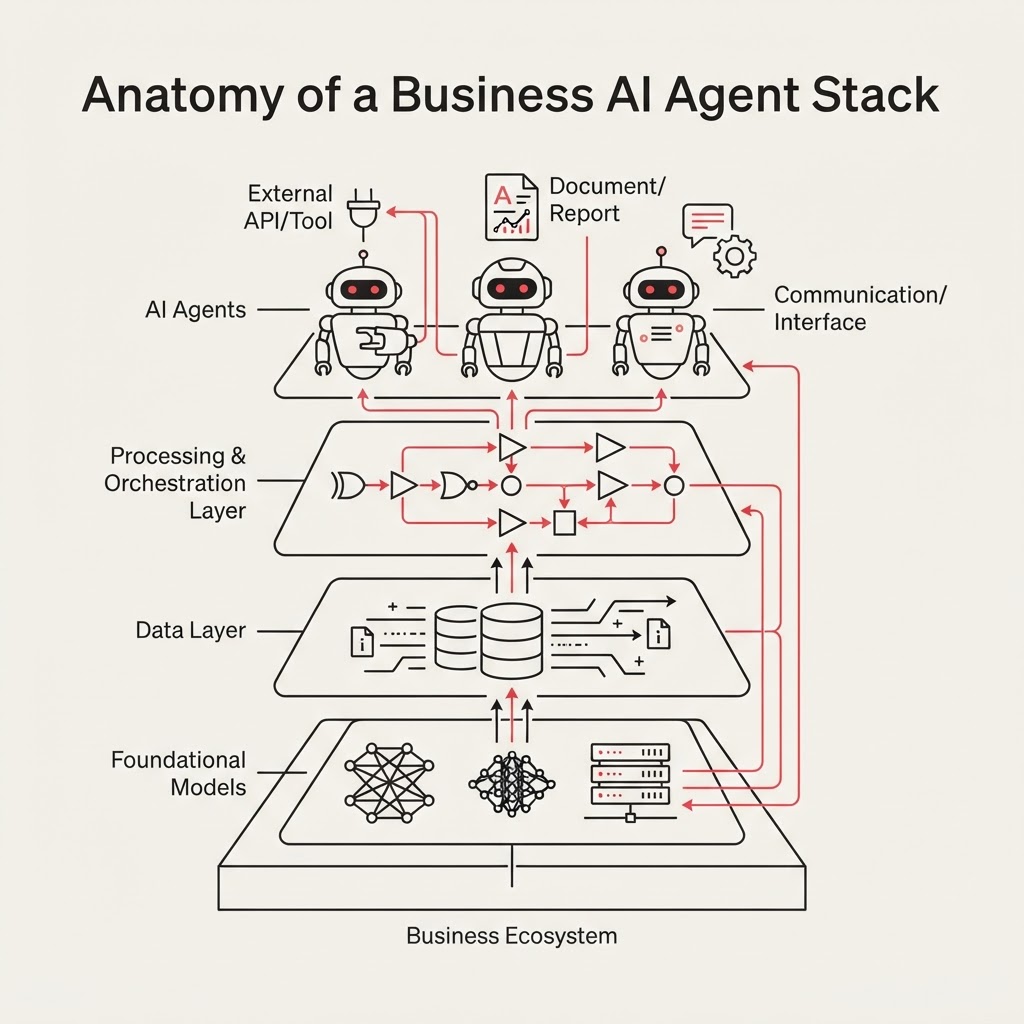
Architecting for enterprise-grade AI requires moving beyond simple chatbots toward modular, multi-agent systems (Deloitte, InfoWorld). By structuring the agent stack into distinct, interoperable layers, organizations can avoid vendor lock-in and maintain the flexibility needed to upgrade individual components as the underlying technology changes (Glean). This architectural approach is fundamental to understanding how these systems operate, a topic explored further in our guide on Core Concepts of AI Generation & Agents.
Layer 1: Intelligence (The Brain)
The core of the stack is the foundation model, which drives the agent's cognition. While general-purpose LLMs are powerful, enterprise efficiency is often found by deploying smaller, specialized models tuned for specific tasks—such as financial analysis, legal review, or code generation—to optimize for both latency and cost.
Layer 2: Knowledge & Context
Agents require a robust knowledge base layer that serves as an abstraction for accessing and unifying data from disparate internal systems (Glean, InfoWorld). Through Retrieval-Augmented Generation (RAG), agents ground their outputs in proprietary enterprise documentation, PDFs, and databases. Furthermore, effective systems manage memory through a combination of short-term state retention and long-term vector indexing, ensuring the agent remains relevant across long-running tasks.
Layer 3: Skills & Rules (The Harness)
Often called the agent harness, this execution layer acts as the orchestrator for the entire system (Tencent Cloud). It is responsible for handling the agent's core loops, defining behavioral boundaries, and enforcing deterministic outputs through structured schemas. This layer ensures that the agent follows compliance guardrails and maintains system instructions even when handling complex, non-linear workflows.
Layer 4: Tools & Integrations (The Hands)
To transition from information retrieval to tangible business impact, agents must interface with existing enterprise software. This layer provides API connectors to systems like ERPs, CRMs, and communication platforms, allowing agents to perform read and write transactions. Additionally, specialized parsers handle unstructured data inputs, such as invoices and contracts, enabling the agent to bridge the gap between static documents and actionable tasks.
Layer 5: Governance & Controls
High-stakes business environments require strict management of agent autonomy (Deloitte). This layer implements human-in-the-loop checkpoints for high-risk actions—such as financial disbursements—and ensures comprehensive observability through logging and audit trails. By maintaining rigorous monitoring, engineering teams can trace agent decision-making and ensure safety, as outlined in our process for How to Set Up an AI Agent.
Building a robust AI agent stack is an iterative process. By decoupling the intelligence layer from the execution harness and knowledge base, teams can ensure their infrastructure remains resilient and adaptable to the rapid pace of AI innovation.
Frequently asked questions
What is the primary purpose of the agent harness?
The agent harness serves as the orchestration layer that manages agent loops, tool interfaces, memory subsystems, and security sandboxing to keep operations reliable.
How does RAG benefit the enterprise agent stack?
RAG, or Retrieval-Augmented Generation, allows agents to access and unify proprietary enterprise data from internal systems, ensuring that agent actions and answers are grounded in company facts.